


Self-Funding Change
Change that pays for itself.
Self-funding change is a practical way to modernise while the operation is under pressure.
We release capacity and savings from your day-to-day operations first, then put that headroom to work - and you choose where it goes: better customer experience, new revenue streams, stronger and happier teams, bottom-line savings, or the capacity to grow.
Each step funds the next, so progress isn’t gated by the annual budget cycle and doesn’t depend on a large up-front investment.














What you can expect
-

Earlier value you can evidence
Delivered in phased waves, so benefits are visible early rather than deferred to the end of a programme.
-

Capacity released safely
Less rework, fewer handoffs and reduced manual effort, without destabilising live services.
-

A clear value waterfall
Quick wins first, stabilisation next, then deeper change once the operation can absorb it.
-

Minimal disruption to BAU
Incremental delivery rather than big-bang transformation programmes.
-

Better adoption and benefit retention
Onboarding, operating model alignment and continuous improvement built in from the start.
-

Stronger leadership confidence
Transparent tracking of benefits, risks and trade-offs, so decisions are grounded in evidence.
-

Compounding reinvestment
Savings and released capacity are reinvested to fund the next wave of improvement.
-

Sustained operational performance
Performance is protected as change progresses, ensuring service, compliance and customer outcomes remain stable.
Self-funding transformation, proven in practice
-
Annual cost avoidance
£950kCapacity freed through better flow and reduced failure demand
-
Customer time saved per year
100,000 hoursAnnual on-hold time reduced through improved access and flow
-
Telephony cost optimisation
from£600k→to£350kTelephony spend optimised to release reinvestment budget
-
Focused delivery within full programme
from8 weeks→to28 weeksActive improvement delivered within a longer programme lifecycle
Why self-funding, sustainable change matters now
Most organisations are trying to modernise while services are stretched and budgets are tight. The self-funding model is built for exactly that moment: rather than waiting for a big investment case to clear, you release value from the operation first and put it to work straight away.

The five destinations
Every wave of efficiency we engineer creates a choice. Where the value goes is yours.
-
Experience
Better customer experience – raise the quality of every interaction, not the headcount.
Released capacity goes back into the moments that matter: resolving issues first time, handling complex cases with care, going further for the customer or citizen on the line.
You'll see it in the scores boards and regulators watch – higher NPS and CSAT, more first-time resolution, lower customer effort and fewer repeat contacts.
-
Effectiveness
New revenue – turn a cost centre into a revenue engine and do what wasn't possible before.
Welcome calls, retention outreach and revenue-protecting callbacks – the high-value work that disappears under inbound pressure – go back on the schedule.
You'll see it where revenue lives: churn falling, more revenue protected and retained, and the outreach calls that used to get dropped now consistently made.
-
Employee
Stronger, happier teams – invest in your people, and customers feel it.
Released time goes into coaching, cross-skilling and career development, and the volume pressure that drives people out comes down.
You'll see it in the health of the team: attrition and absence falling, engagement rising, and a workforce skilled across more of the work.
-
Efficiency
Real, sustainable savings, straight to the bottom line.
Headcount comes down through natural attrition rather than forced exits, and cost-per-contact comes down with it. The change funds itself and keeps paying.
You'll see it on the P&L: lower cost-per-contact and cost-to-serve, a clear payback period and a net saving that drops to the bottom line.
-
Expansion
Room to grow – absorb growth without growing the cost base.
Capacity scales on released efficiency rather than headcount – more customers served, more accounts onboarded, more activity handled with the team you already have.
You'll see it as you grow: more volume absorbed without more cost, cost-per-contact holding steady as activity rises, faster onboarding and a stronger growth-to-cost ratio.
How a small start becomes a large transformation
It starts with one small investment. The saving it releases funds the next step, and the next -- so a modest start adds up to a large overall reduction in cost, with no new budget needed after the first move.
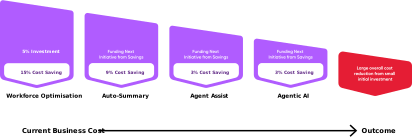
The chart shows the reinvestment path – each saving funding the next step. But the saving released at every step is yours to direct: compound it into the next initiative, as shown, or send it to any of the five destinations. Your call, at every step.
And it doesn't have to start in the contact centre – the same compounding applies when the first move is a network or security rationalisation that releases run-cost to fund what follows.
Delivering Proven Outcomes
ID&V verification up from 35% to 49%, around 1,500 more customers self-serving every month across roughly 19 million interactions a year - the AutoSummary efficiency paid for the consulting and the technology. Now a five-year embedded contract.
-
ID&V verification
from35%→to49% -
More customers self-serving every month
1,500 -
Interactions a year
~19 million



Outcomes you can evidence, not just implement
Most transformation programmes deliver a go-live. Leaders need sustained, demonstrable value. FourNet builds value certainty into self-funding change by agreeing what success looks like, measuring it consistently, and staying engaged after launch so released capacity and savings are not lost.

-
Baseline and outcomes defined upfront: measures, owners and an evidence plan
We agree what success looks like before delivery begins. That means defining clear measures, accountable owners and an evidence plan that links operational change to financial and service impact. This creates transparency from day one and ensures benefits are tracked, not assumed.
-
Delivery in waves for speed to value, not big-bang risk
Change is sequenced into controlled waves so early improvements release capacity quickly while protecting live services. This reduces programme risk, avoids operational shock and ensures value is visible and measurable at each stage.
-
Forward deployed engineers to turn insight into safe change quickly
Insight alone does not create value. Our engineers embed early in the engagement to translate analysis into practical, governed change. This shortens the gap between identifying opportunity and delivering improvement, while maintaining service stability and compliance.
-
Governance and reporting that stands up to scrutiny
Leaders need clarity, not dashboards without context. We build governance frameworks and reporting cadences that provide clear visibility into performance, released capacity, risks and trade-offs -- giving confidence at board and operational level.
-
Adoption, service transition and continuous improvement so benefits don’t leak
Benefits are protected through structured onboarding, clear operating model alignment and ongoing optimisation. Service transition is planned, not assumed, ensuring released capacity and cost savings are sustained rather than eroded over time.

Start Your Self-Funding Change Journey Today.
Explore how your organisation could unlock efficiency savings, redirect resources and fund transformation without increasing operational cost.
How FourNet delivers self-funding, sustainable change
A natural sequence your board can approve a step at a time: fix the experience first, where the pain and the business case are clearest; protect what you’ve fixed with a secure foundation; then scale AI on top - a low-risk expansion, not a leap of faith, because the foundation is already proven.
-
Baseline reality first
Establish cost, capacity, demand and failure demand using operational data and journey truth
-
Build a value waterfall
Sequence work so early improvements release headroom and stabilisation protects performance
-
Deliver across people, process and technology
Remove rework, improve controls and align tooling to how work is actually done
-
Move fast with forward deployed engineers
Embed delivery capability early so insight becomes safe change
-
Connect foundations to value retention
Strengthen connectivity, secure access and platform observability so released capacity is not lost to instability or recovery work
-
Track value as you go
Define measures per wave (capacity released, backlog reduction, unit-cost proxies) with a cadence leaders trust
-
Make benefits stick
Onboarding, adoption, service transition and continuous improvement built in
-
Bring the right specialists to each wave
A specialist team built for transformation – AI, data, cyber, service design, networks and workforce optimisation – alongside the operators who've run services at this scale.
-
Security funded by the change
Security usually arrives as a separate bill. Here it's funded by the change itself – the capacity and savings the early waves release pay for the secure foundation that protects them. Cyber, network and AI under one accountable partner, architected in rather than bolted on.
Our services to drive self-funding, sustainable change
Most providers can release value in the contact centre, then watch it leak through fragile networks and unmanaged risk. FourNet runs the whole stack - CX, networks and cyber, converged under one accountable partner - so the value you release in each wave is value you keep.
-
Release the value
Find and free the capacity and savings in the operation
-
Run leaner foundations
Cut run-cost that funds the next wave
-
Protect the value.
Make sure released value isn't lost to outages, incidents or recovery.
Let’s talk about what you’re trying to achieve
Our Approach
-
Discovery
Understand the service challenge
-
Analysis
Review where disruption, accessibility and complex journeys create support needs
-
Roadmap
Shape a roadmap for better digital journeys and assisted service
"The modernisation has given us the agility we need to support our community in a changing world, and FourNet’s partnership made it all possible."



If you’re already a client, please call us at 0845 055 6366 or email hello@fournet.co.uk.
Insights that help you advance self-funding change



FAQs
-
What is self-funding, sustainable change?
An approach where early operational improvements release capacity and savings that fund the next phase of change – so transformation pays for itself rather than relying on large up-front investment. The value you release is yours to deploy across five destinations: Experience, Effectiveness, Employee, Efficiency and Expansion. You choose where it goes.
-
Which teams can FourNet help improve?
Customer contact operations, case-handling and back-office teams, workforce planning, digital services and technical operations where instability and manual effort drive cost.
-
How quickly can we see value?
Often within weeks, because the first wave focuses on visibility, flow and targeted fixes using what you already have.
-
How do you stop benefits leaking over time?
By building adoption, governance and continuous improvement into delivery, and by ensuring secure, resilient foundations protect the value released.
-
Do we have to reinvest the savings in more transformation?
No. The value released is yours to use as you choose. Take it as a saving to the bottom line, reinvest it in better service or new revenue, put it into your people, or use it to absorb growth – or any mix of the five. The model gives you the choice; it doesn't make it for you.
-
Will this mean redundancies?
No forced exits. The efficiency route is built on natural attrition – managing headcount down over time as people move on, rather than through restructuring or redundancy.