

The Trauma Load Index
Burnout, sickness and resignation in UK ambulance and police control rooms aren't random, they follow patterns that can be measured. The Trauma Load Index is FourNet's workforce intelligence framework, built on 30 years of peer-reviewed occupational psychology and fatigue science. For the first time, it gives supervisors and operations leaders a real-time, objective measure of cumulative psychological load — call by call, shift by shift, agent by agent.
The Hidden Crisis
Sickness, attrition and burnout aren't random events. They are predictable, measurable, and preventable.
-
35%
Annual attrition in police force control rooms
Nearly double the NHS overall average. Some trusts exceed 12%.
-
9.6%
Average sickness absence in UK ambulance control
After frontline response, the largest contributor to police workforce loss.
-
46%
Of controllers exhibiting symptoms of Secondary Traumatic Stress Disorder.
After frontline response, the largest contributor to police workforce loss.
-
£32k
To recruit and train one operational replacement
A 200-seat control room is losing £4–4.5 million a year to a problem nobody is measuring.
What the Trauma Load Index Measures
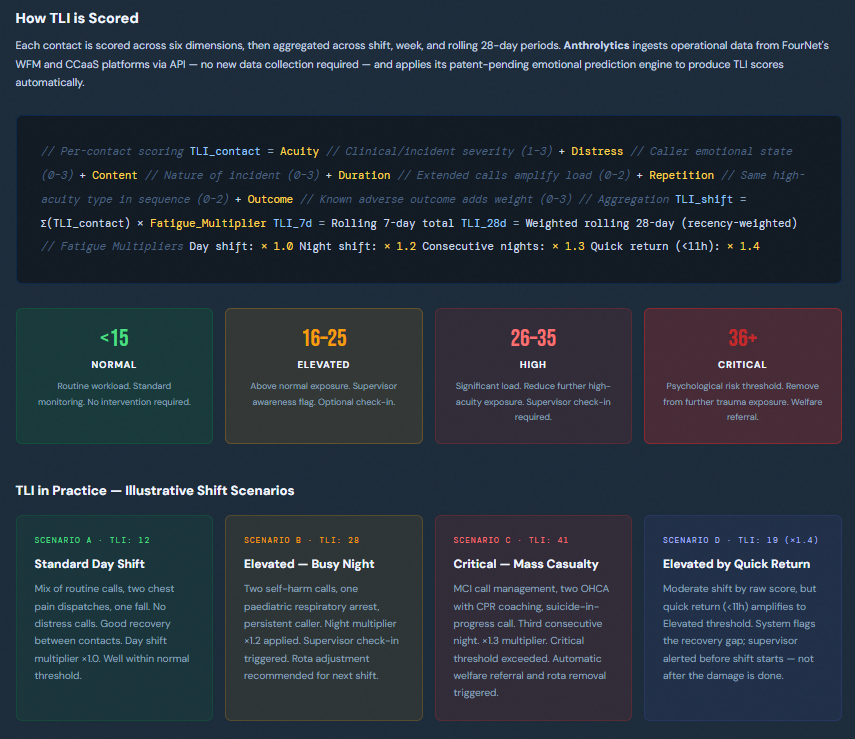
Six dimensions, scored automatically. Per contact, per shift, per rolling 28 days.
Every contact is scored automatically across six observable variables, using data already flowing through the workforce management and contact centre estate. No surveys. No self-report. No new data collection.
Acuity
Clinical or incident severity. Cardiac arrest, threat-to-life, mass casualty incidents escalate the score.
Distress
Caller emotional state, detected through speech analytics. Calm, anxious, distressed, hysterical.
Content
Nature of the incident. Self-harm, paediatric trauma, domestic violence carry weight.
Time
Extended call duration amplifies emotional load and reduces recovery between contacts.
Repetition
The same high-acuity type back-to-back compounds load. The second cardiac arrest call is not the same as the first.
Outcome
Known adverse outcomes (death, serious injury) add weight retrospectively.
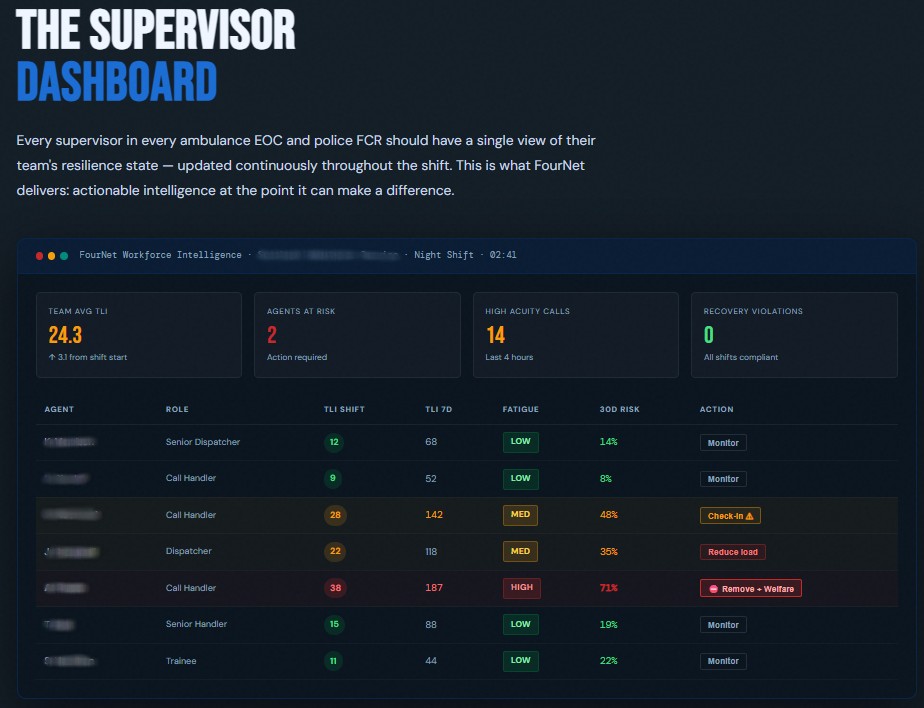
What it produces
Built on the Science
Why FourNet
We work both sides of the line.
FourNet is the only UK technology partner treating customer vulnerability and agent vulnerability as one connected safeguarding responsibility. Two years of vulnerability research now underpin our customer-side category library – bereavement, carer pressure, suicidal ideation. The same discipline now applies to the agent. Our framework is vendor-agnostic, partnered with Anthrolytics for the predictive engine, and deployed live in 999 control rooms, NHS trusts, police force control rooms, housing associations and debt advice charities. Every place where vulnerability is the whole job, not a feature.
Talk to FourNet about the Trauma Load Index.
Request a 60-minute briefing with FourNet’s workforce intelligence team. We will walk you through the framework, the deployment phases, the union and welfare governance, and the realistic outcome ranges from current pilots. No obligation. No technology procurement attached.