


Five Step Framework for Artificial Intelligence Adoption in Customer Service
This guide explains how you can effectively adopt AI across self-service, agent assist, routing, analytics and workforce optimisation. Along with steps to build a business case that aligns with today's governance expectations.
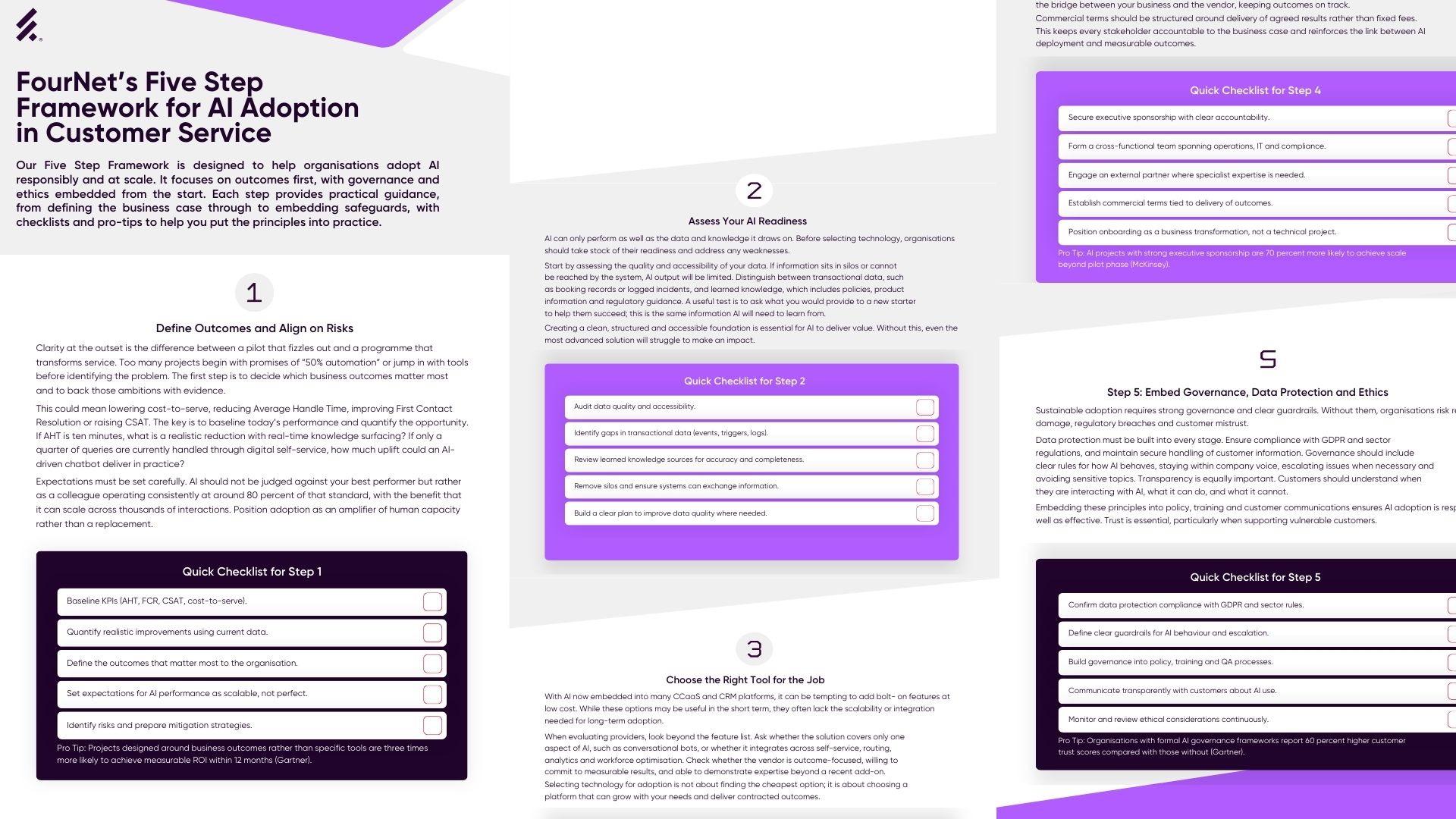
Artificial Intelligence Adoption in Customer Service and Contact Centres
Artificial Intelligence (AI) has rapidly shifted from being a shiny new toy, to a tool that is shaping strategies and organisational change. In 2024, 78% of organisations across the UK were using AI within their organisation and this number has undoubtedly increased since then.
It's easy to see how Generative AI tools are transforming creative and back-office departments, but when it comes to customer facing departments, adoption has been a little slower. However, with the development of Agentic AI, Speech Analytics and Real-time Agent assist, adoption of AI is accelerating in service and contact centres. In fact, a recent survey found that AI assistance has increased customer-support productivity by 14%.
But, due to a lag in strategy and governance, many organisations have developed a "bring your own AI" attitude towards these tools; with separate teams and using AI in silos, with no clear alignment or policy for use.
What We Mean by “AI”
When we talk about AI in this context, we're referring to a broad spectrum of technologies that combine automation, language understanding, decision-making, and learning. This includes everything from conversational AI to systems like real-time speech analytics, AI-assisted agent tools, and Agentic AI that can carry out multi-step workflows.
In practical terms, it covers:
- Conversational interfaces that understand and respond to natural language.
- Intelligent assistants that support agents during live interactions with summarisation, sentiment tracking, and knowledge surfacing.
- Machine learning systems that power smarter routing, customer insights, and performance analytics.
- Agentic AI, which can take a goal and work through multiple steps to achieve it -- autonomously or in partnership with a human across a range of customer service tasks.
AI, in this guide, is not a single product or feature. It's a layered, evolving set of capabilities that--when adopted strategically--transform operations, improve outcomes, and align with governance and compliance expectations.
What Benefits Are Contact Centres Seeing With AI?
AI in contact centres is now delivering hard results, and not just in productivity. As mentioned at the start of this guide, 78% of organisations using AI have seen measurable improvements in KPIs.
First Call Resolutions (FCR) is up to 20% higher in centres using AI-powered routing and agent assist, while Average Handle Time (AHT) drops by 10-15% thanks to real-time knowledge surfacing, next-best-action prompts, and integrated Automation. Conversational AI bots can now handle entire webchat queries, freeing agents for more complex work.
It's also improving customer experience by building stronger relationships through hyper-personalised customer journeys. This can have a dramatic impact on revenue, as personalised experiences can generate up to 40 percent more revenue than cookieâ€'cutter ones, and 80 percent of consumers are more likely to buy when they feel seen.
A big win for AI is opening the door to 100% call monitoring, a figure that was impossible for larger contact centres through manual Quality Assurance (QA) checks, which previously averaged out at around 1-2%. By leveraging AI-enabled Speech Analytics, organisations are saving hundreds of hours previously tied up in manual listening and evaluation. Instead of slogging through full call recordings, QA teams can search transcriptions to find issues in 50% less time, while still ensuring every call is captured and optimised for insights and compliance.
Main benefits and figures:
- Productivity: +14% overall, +34% for new agents (Stanford/MIT)
- First Contact Resolution: Up to +20% ([FourNet case data])
- Average Handle Time: -10-15% (Contact Babel)
- Customer Satisfaction: 85% say AI personalisation builds relationships; 78% say it improves speed (Salesforce)
- Automation Forecast: 10% of all agent interactions fully automated by 2026 (Gartner)
- Quality Management: 100% call monitoring vs. 1-2% manual (Contact Babel)
Retention impact: +25-95% profit with +5% retention (Invesp)