

Modernising Voice and Contact Centre Services for the UK’s Largest University
Learn about the transformation project that FourNet delivered in partnership with the University of Manchester, where we migrated 21,000 numbers to Teams Voice and introduced NICE CXone Mpower to modernise contact centre services at scale.
Leading Change at the University of Manchester
The University of Manchester (UoM) has a reputation for being a pioneer in science and technology, from developing the world’s first stored-program computer to advancing research in graphene and medical innovations.
With over 43,000 students and up to 25,000 staff, UoM operates on a huge scale, supporting everything from teaching and research to administrative services across its campus sites. Looking ahead, UoM aims to enhance its digital capabilities further, ensuring seamless collaboration in a hybrid world while maintaining its position at the cutting edge of education and discovery.
This forward-thinking approach means investing in infrastructure that not only meets today’s demands but also adapts to emerging technologies like AI and automation.
Project in Figures
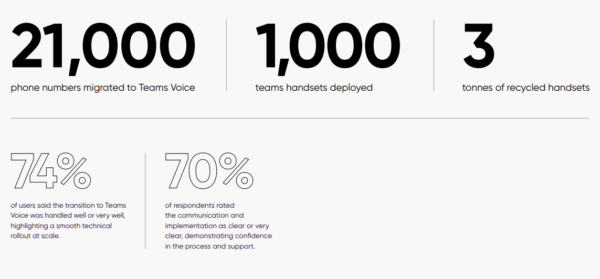
*All data taken from Teams Voice Project End of Project survey (mix of IT support Staff and End-Users i.e, Call-Queue Owners)
Overcoming the Limitations of Legacy Systems
For over three decades, the University’s telephony system primarily relied on Siemens Hicom 300 systems, installed around 2000-2001 and later upgraded to HiPath 4000 in the late 2000s, managing 20,000 to 30,000 ports. While two HiPath exchanges continued to be upgraded to support a small number of critical lines, maintaining the wider estate had become increasingly challenging and costly. Even routine tasks such as replacing handsets across an extensive campus had become resource intensive. The reliance on ISDN30 lines also added urgency, given the UK PSTN and ISDN switch-off. The legacy setup also struggled to support post-pandemic hybrid working, where staff needed flexible, reliable communication; particularly in specialist environments where dependable connectivity was essential for research and teaching.
The challenge extended beyond technology to day-to-day service delivery. Recognising these pressures, the University initiated the 'Teams Voice' programme to modernise its voice and contact centre services and create a more resilient foundation for staff and student support.
The goal was clear:
- Reduce the ongoing costs of maintaining legacy systems
- Adapt to working habits and improving flexibility
- Build a foundation that would safeguard against future disruptions while enabling better support for students, researchers, and administrators.
Delivering ‘Teams Voice’ Step by Step
The project unfolded in three distinct phases, each designed to minimise disruption while tackling the scale of migrating thousands of users across a University with over 43,000 students and a vast network of facilities. This careful staging meant we could test, learn, and scale up without risking the daily communications that keep teaching, research, and administration running smoothly.
Phase 1
In the first phase, UoM launched a pilot involving 1,000 users, selected from various departments to represent the University’s diverse operations, and used Gamma Direct Routing to connect Microsoft Teams Voice in a controlled setting. This allowed the team to simulate real-world usage, identify potential integration hurdles with existing tools like email and calendars, and make adjustments on the fly. User feedback was gathered through surveys and focus groups, ensuring the setup not only worked technically but also felt intuitive for staff juggling lectures, lab work, and remote collaborations. Throughout, rigorous testing protocols kept services uninterrupted, building confidence for the wider rollout.
What is Gamma Direct Routing?
Gamma Direct Routing enables businesses to make and receive external calls directly through Microsoft Teams by connecting the platform to the public telephone network (PSTN) via SIP trunks. It provides a flexible, cost-effective way to integrate voice services without needing additional hardware, ensuring seamless connectivity for users.
Phase 2
Phase two centred on the complete replacement of the ageing Siemens PBX with FourNet’s Agile Cloud Teams Voice solution, which involved migrating almost 30,000 ports in managed batches over several months to handle the University’s enormous scale. Powered by 500 Gamma SIP trunks (with full Active / Standby resilience), this upgrade delivered reliable, high-quality voice connections that could scale with demand, such as during peak enrolment periods or major events.
Coordination was key, with cross-departmental workshops and phased cutovers timed outside business hours where possible, plus real-time monitoring to catch and resolve any issues instantly. Redundancies like backup lines and failover systems were built in from the start, safeguarding critical areas of the University where even brief downtime could halt valuable research.
What is FourNet’s Agile Cloud Teams Voice?
FourNet’s Agile Cloud Teams Voice is a managed Direct Routing service that integrates Microsoft Teams with cloud-based telephony, enabling external calling and advanced features like call queuing and analytics. It replaces traditional PBX systems with a scalable, Azure-hosted solution that supports hybrid working and reduces maintenance costs.
What are Gamma SIP Trunks?
Gamma SIP Trunks connect your communication systems to the public network over the internet, replacing outdated ISDN lines with flexible, reliable voice channels. They support inbound and outbound calls, offering features like number portability and disaster recovery to keep connections stable.
Phase 3
The third phase introduced FourNet's NiCE CXone Mpower as the new contact centre platform, transforming how student enquiries, staff support tickets, and external calls were managed through intelligent routing that directed issues to the right experts quickly. This included setting up omnichannel support for email, chat, and voice, with built-in analytics to track response times and identify bottlenecks in high-volume areas like admissions or IT helpdesks. While the majority of users are pleased with the change of platform, we are continuing to work with users that have more advanced and specific requirements; building them into the new platform.
Training sessions for agents focused on the new tools, helping them handle queries more efficiently without added pressure, while automation features like self-service options reduced wait times for users. Regular progress reviews and contingency measures ensured no drop in service quality, even as the system went live across the University’s multiple sites.
What is NiCE CXone?
NiCE CXone Mpower is an AI-powered cloud platform for contact centres that combines routing, analytics, and automation to deliver better customer experiences. It supports multiple channels, helps optimise workforce performance, and uses data insights to resolve issues faster, making it ideal for large organisations like universities.
Partnering with Another Manchester Native: FourNet
When it came to finding the right path forward, the University of Manchester turned to FourNet, a fellow Manchester native, and trusted integrator with deep expertise in cloud telephony and customer experience. FourNet worked closely with the University to assess options, drawing on our track record of delivering scalable solutions for large public and private sector organisations.
What sets FourNet apart is our focus on understanding the unique needs of each client, ensuring the technology aligns with their operations rather than forcing a one-size-fits-all approach. This collaborative process helped identify Microsoft Teams Voice as the ideal platform, combined with partners like Gamma for SIP trunks and NiCE for contact centre capabilities, to create a resilient and efficient system.
Central to the project’s success was the partner ecosystem FourNet curated, where Gamma supplied 500 SIP trunks to ensure clear and dependable voice connections. NICE contributed CXone, boosting contact centre efficiency with features that handle queries more intelligently. As the lead integrator, FourNet unified these components seamlessly, aligning everything to the University’s needs and minimising any potential disruptions for staff and students.
Realising the Benefits of Modernisation
The results were transformative, with the University moving to a cloud-based system that improved mobility for staff and supported hybrid working, while reducing the overhead of maintaining legacy telephony. Costs have been reduced through streamlined maintenance, and the shift has enabled true hybrid working, allowing teams to collaborate effectively regardless of location.
Recycling old handsets contributed to sustainability efforts, turning potential waste into a positive environmental outcome. At the project closure event in September 2025, Registrar and Chief Operating Officer Patrick Hackett highlighted the seamless execution, noting how it positioned the University for long-term success.
“The modernisation has given us the agility we need to support our community in a changing world, and FourNet’s partnership made it all possible.” Patrick Hackett, Registrar and Chief Operating Officer, University of Manchester
Built for What Comes Next
With the modern platform in place, the University now has a stronger foundation to keep improving how it supports staff and students, refining routing, expanding reporting and insight, and enabling future automation where it adds real value.
FourNet will continue to support the University as it optimises services over time, combining practical delivery with the governance and assurance needed for mission-critical environments.
Further Reading


Improving Student Experiences at Runshaw College with Next Generation Wi-Fi from Extreme Networks
Find out More