
Government Efficiency in Practice: Self-Funding Transformation After GTN
December 5, 2025

When we decided to sponsor the Government Efficiency table at Government Transformation North (GTN) in Manchester, it wasn't about another logo on a slide. It was because the questions on that table are exactly where FourNet spends its time:
How do you improve outcomes, reduce avoidable demand and evidence real efficiencies without cutting services or burning out your people?
That conversation is now framed by the Government Efficiency Framework (GEF), which sets out how departments should define, calculate and report efficiency gains from 2023-24 onwards. At the same time, the government's digital roadmap and the new blueprint for modern digital government ask for a public sector that is more efficient, more digital and more joined-up by 2025, not simply smaller.
This blog brings those strands together:
- FourNet's self-funding digital transformation model and the familiar financial waterfall we use in CX consulting
- The Government Efficiency Framework and its definitions of technical and allocative efficiencies
- Real, anonymised examples from justice-related services and Newcastle City Council, showing how this plays out in practice
What "efficiency" really means in 2025
The GEF is very clear about what counts as an efficiency - and what doesn't.
In simple terms, an efficiency is delivering the same or better outputs and outcomes with fewer inputs, or delivering more or higher-quality outputs for the same level of input. Reductions in service levels or outcomes do not count, even if they save money.
The framework distinguishes:
- Technical efficiencies - carrying out activities with fewer resources, or to a higher standard without additional resources.
- Allocative efficiencies - moving funding and effort to activities where there is a better ratio of costs to benefits.
It also expects departments and ALBs to:
- Use robust data to underpin claims
- Show the net effect after costs and disbenefits
- Demonstrate that benefits are recurring, not one-offs
- Be transparent enough that HMT, NAO and the public can follow the logic
Layered on top of that, departments are working to a renewed focus on productivity and efficiency targets and a digital agenda that includes "buy once, use many times" technology, better data, and modern platforms.
That's the environment we design our approach for.
Our self-funding transformation model - and the waterfall
Across central government, justice and local government, our CX & contact-centre work follows a repeatable pattern.
We start by establishing a clean baseline of cost-to-serve: demand into the contact centre and digital channels, reasons for contact, handle times, repeat contact, failure demand, rework, and the internal handoffs hidden behind each interaction.
From there, we identify where you can remove wasted effort, improve journeys and use technology to support your teams:
- Quick operational changes such as better knowledge, clearer letters and scripts, routing tweaks or smarter queue messaging.
- Structural changes such as consolidating channels, standardising processes and using digital self-service for simple tasks while retaining assisted channels for complex or vulnerable users.
- Targeted use of AI and automation to support agents, summarise cases, surface insight and remove low-value manual work.
The financial view is presented as a waterfall:
- A left-hand bar showing the current cost and effort (people, platforms, rework).
- A series of steps where each intervention delivers a quantified benefit - fewer avoidable contacts, shorter calls, reduced handoffs, faster case progression.
- A right-hand bar showing the net position after reinvestment in further digital and data improvements.
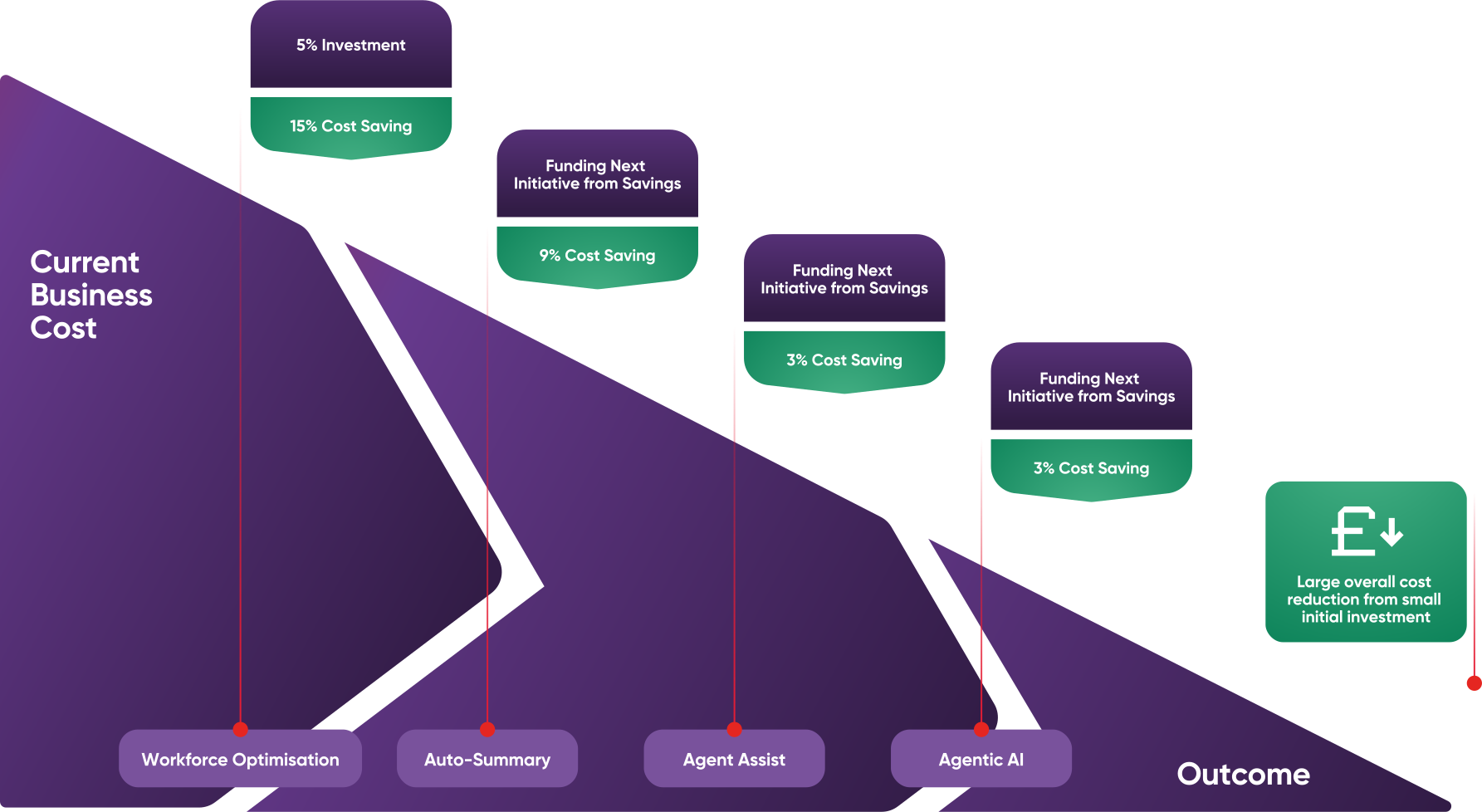
The crucial point is that this is self-funding. Early savings and capacity release are used to pay for the next phase of change. You end up with better services, better data and more resilient operations, not just cuts and a brittle system.
How that maps directly to the Government Efficiency Framework
If you place the GEF lens over that waterfall, the alignment becomes straightforward.
The quick wins and operational fixes fall squarely into technical efficiency:
- The same services are delivered to at least the same standard.
- Fewer contacts are required per case; calls are shorter and better resolved.
- Back-office staff spend less time dealing with avoidable rework or chasing.
As you move into structural changes, you combine technical and allocative efficiencies:
- Demand is handled through more appropriate channels and clearer journeys.
- Staff time is released and re-allocated from repetitive, low-value activity to complex casework, safeguarding or policy.
- Infrastructure and platforms are rationalised so you are not paying multiple times for overlapping capability.
Finally, as you apply automation and AI, you are looking at sustained technical efficiency gains - more work handled to at least the same standard without extra resource - that can be tracked over time.
Crucially, we calculate these effects net of implementation and run costs, and we use datasets that finance and audit colleagues can interrogate. That is what the framework is asking for.
A high-volume life-event service: fewer chasers, more certainty
One anonymised central-government programme we referenced at GTN focused on a high-volume civil service where people apply for official confirmation of a change in their personal circumstances. It is a classic life-event journey: emotionally loaded, time-sensitive and very documentation-heavy.
The starting picture will sound familiar:
- Large volumes of paper or scanned documents
- Limited end-to-end visibility of case status
- High numbers of "has my application been received?" and "what's happening now?" calls
- Staff spending time chasing information across teams instead of progressing cases
Our joint team used contact-centre and operational data to understand where effort was being wasted. We then redesigned the journey around a small number of practical changes: clearer digital and letter templates, better capture and routing of incoming documents, and proactive status updates at key points.
The result was that the same number of applications were processed, often more quickly, with far fewer inbound chaser calls and less internal rework. People got clearer information; staff could focus on progressing cases instead of hunting for them.
From a GEF perspective, that is pure technical efficiency. Outputs and outcomes are at least maintained - in practice, improved - while the resource required per case comes down in a way that can be evidenced.
A complex estates service: understanding where time is really spent
A second anonymised example comes from a specialist service dealing with the administration of estates and related financial matters after a bereavement. Here, the core challenge was a sense that everything took too long and no-one could clearly explain why.
Data was fragmented between case systems and the contact centre. People had a rough intuition about where bottlenecks were, but no shared view.
We worked with the organisation to create an end-to-end picture of each case, combining:
- Milestones in the core case system
- Contacts from citizens, representatives and third parties
- Internal handoffs and points of rework
That allowed us to see where cases stalled, how different teams compared, and which communications were driving repeat contact.
Once that insight was in place, relatively modest changes made a real difference: targeted staffing adjustments at specific points in the journey, clearer communications to set expectations, and management information that helped teams act early rather than react late.
Again, through the GEF lens this is a textbook technical efficiency. The organisation delivers the same critical service, but with:
- Shorter and more predictable timelines
- Fewer "what is happening with my case?" calls
- More staff time available for complex, contested or safeguarding-related issues
Nothing about the service is hollowed out; it simply works better.
Newcastle: using contact-centre data to unlock local capacity
In local government, our work with Newcastle City Council shows how the same principles apply in a different context.
Newcastle was dealing with all the challenges you would expect of a large city: high demand across council tax, waste, housing and repairs; multiple channels; and legacy platforms that made it harder for teams to see what was really going on.
We began by building a clear demand profile from contact-centre and digital data - what people were calling about, how often, via which channel, and how those contacts translated into work for back-office teams.
That insight made it possible to:
- Fix specific broken processes that were generating unnecessary contact
- Simplify and clarify online journeys, so more residents could self-serve for simple tasks
- Adjust resourcing and skills mix in the contact centre to match actual demand
- Use a modern platform to give leaders and teams better MI in real time
For the council, that translated into fewer contacts per issue, better first-contact resolution and more time for complex or vulnerable cases, all without increasing headcount.
For the GEF, this is a blend of technical efficiency (lower cost-to-serve) and allocative efficiency (re-directing capacity to higher-value tasks) that can be evidenced from the data.
Genuine efficiency: making work more efficient, not just doing less
A theme running through the GTN discussions was the gap between rhetoric and reality. It is very easy to talk about "efficiency"; it is much harder to show that you have:
- Made work genuinely easier and more effective for staff
- Improved the experience and confidence of citizens
- Delivered recurring, auditable savings or capacity release
That is where we believe contact centres, frontline operations and the data they generate are uniquely powerful. They provide a real-world view of how services are performing, where effort is being wasted and where technology can help teams handle more of the right work, to a higher standard, rather than simply cutting contact.
Our role is to bring together:
- The Government Efficiency Framework and the digital transformation agenda
- A self-funding financial model with clear waterfall analysis
- Practical experience from real services - from life-event casework to city-wide operations - where efficiencies have already been delivered
If you are working through your own efficiency plans following GTN, and want to test whether your CX, contact-centre or operational proposals will stand up against the GEF, we'd be happy to work through that with you - in the same spirit as the conversations around the table in Manchester.